Tech n' Cars: google+ Blogger Widgets
Showing posts with label google+. Show all posts

July 05, 2012

Apple to Launch iPad Mini in October


It seems as if every year holds something different for tablets. According to Steve Jobs, 2010 was the year of the iPad. 2011, I'd say, was the year of the competitors. Samsung, Motorola, Sony, and many more companies tried to compete with the iPad. But what was 2012 the year of? Not the iPad 3; while its retina display was a significant change, it wasn't as much of a hit as the iPad 2. I'd say 2012 was the year of the budget tablets.

First, some iPad wannabes started surfacing. Though they costed as little as $99, they had awful specs and couldn't compete with Apple's offering at all. Then, Archos started making tablets for the price of just $250; half of the cheapest iPad. While this was quite amazing, the public didn't seem very interested, possibly because Archos isn't a very popular brand. Then, Xtex came out with the My Tablet, a $150 ICS tablet with a 7" screen. It fared slightly better, but the screen was extremely low resolution and the app offerings were few. After that, Amazon and Barnes & Noble upgraded their e-reader line with the Kindle Fire and the Nook Tablet. Both were $200 7" tablets running heavily overwritten versions of Android. The Nook Tablet fared fine, but the Kindle Fire became a serious iPad competitor and likely the first successful budget tablet. However, both were geared toward bookworms, not the general audience. A few months ago, Microsoft launched its Microsoft Surface, another budget tablet offering hoping to compete with the iPad. And last week, Google came out with the Nexus 7, a tablet that I'd say has true potential; it has specs comparable to a $400 tablet at $200.

Now, you'll notice something interesting here. In the tablet market, Apple was the first to come, and all the other companies followed up with competitors. But with budget tablets, the people who competed with the iPad are coming first. Apple has long said that it would never make a smaller iPad; Steve Jobs himself said that a smaller iPad screen would severely worsen the user experience.

But now, it's time for Apple to admit that they were wrong. Very many 7" tablets have came out by now, and they are all faring extremely well. I own the Kindle Fire myself, and I would strongly disagree with what Steve Jobs said. He's known for being extremely opinionated, and often right, but in this case, he's been proven wrong.

And, believe it or not, Apple is admitting that they made a misstep. They may be behind in the budget tablet market, but they want to catch up. In October 2012, Apple is most likely going to launch the iPad Mini.
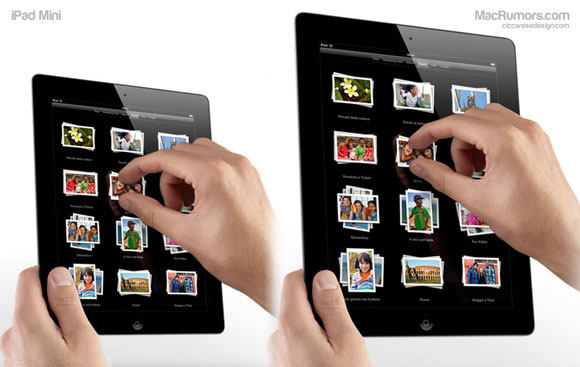
Bloomberg and WSJ both reported that this October, Apple will release the "iPad Mini" alongside the iPhone 5. This iPad will have a 7.85" screen, slightly bigger than the 7" screen of the Kindle Fire, Microsoft Surface, and Nexus 7, but significantly smaller than the 9.7" screen of the current iPad.

To keep the cost of this iPad low, it will not include a retina display, and will have a screen resolution of 1024x768, which is about the same is that of other budget tablets. This means that current iPad apps will be able to be used on the iPad Mini without the developers modifying them. However, the report states that Apple plans to make everything on the screen smaller instead of keeping things the same size but not displaying as much information on one screen.

July 03, 2012

Google's Nexus 7 Looks to Dominate the Budget Tablet Market


For a very long time, tablets have been widely regarded as amazing pieces of technology too expensive for most of us to buy. When Apple released the first iPad in April 2010, most people were blown away by the beauty of the device and the possibilities of what you could use it for. But they were also blown away by the $500 price tag, more than double that of the iPhone's. Later, other companies such as Motorola, Samsung, Asus, Sony, Dell, and Microsoft came out with their own tablets, but it turned out that these were either even more expensive, or simply iPad wannabes with awful specs. It seemed as if tablets would remain a luxury reserved for the- well, luxurious.

But then, a market of budget tablets opened up. Xtex, a small tech company, was the first to really break into this category with their Xtex My Tablet, an Ice Cream Sandwich tablet for just $150. While it wasn't a complete wannabe, it still had the obvious feel of a cheaply made tablet. As one unsatisfied reviewer said, "Don't buy this tablet, it is made of cheap plastic and is not good. Sometimes the touch screen does not respond. Poor Wi-Fi connectivity. Low sound quality."

Then, Amazon and Barnes & Noble upgraded their respective Kindle and Nook lines to include budget tablets. Amazon made the Kindle Fire, and Barnes & Noble made the Nook Tablet. Both were 7" Android tablets with $200 price tags. However, the operating system on both had been heavily overwritten with the company's own operating system, which featured huge eBook stores and thousands of full color magazines available. While both were great tablets at a low price, they were geared towards bookworms rather than the average tablet user.

Now, it seems like Google has hit it big. They just introduced the Nexus 7, a beautiful 7" tablet running Android 4.1 (Jelly Bean). It has a powerful quad-core processor, Bluetooth, a microphone,  a front facing camera, GPS, a 1280x800 pixel display, an amazing feel, and a stunning 9 hour battery life. But the true killer thing about this tablet? Its $200 price tag.


Watch the video above, and you'll see what I mean. The most stunning thing about this tablet, despite its amazing features, is its price tag.

Another great thing about this tablet is that because Google also makes Android, the hardware and the software of this tablet are being made by the same company. Does that sound familiar? It's the very thing Steve Jobs said is what made Apple so successful. In a world where one company would write an operating system and another would make the computer, Jobs thought that computers could be much better if both tasks were done by the same company. And just as this philosophy was used by Apple to change the world of technology, Google is going to change the world of tablets with it.

How exactly did Google use this strategy? Well, take a look at the tablet and you'll see what I mean. First, Google Play, another Google service, is tightly integrated into the tablet. Music, books, magazines, videos, and apps can easily be bought from Google Play and, unlike the multi-step procedure used on other devices, downloaded directly to the tablet. Second, Google Chrome is the default browser on this tablet. Third, they upgraded their Google Maps app for the device. You can see inside locations you're going to, and you can even take virtual tours of the insides of some places. Fourth, it utilizes a lot of Google apps; you can access Gmail right from the homepage, you can use the front-facing camera for Google+ Hangouts, and all your usage syncs with your Google account.

The Nexus 7 will launch July 19, and is available for pre-order on Google's Nexus page. If you pre-order the device, it will arrive with $25 of free Google Play credit.

Update 1: Android 4.1 also has an amazing voice search feature that proves to be even better than Siri. It will likely be seen on this tablet. Check out a video of the feature in action here.

Update 2: Rumor has it that Apple will launch a "Mini iPad" (an iPad with a 7.85" screen) along with the iPhone 5 this October to compete with the Nexus 7.

April 15, 2012

Why Facebook needs to make their own internet browser


In 2008, before Google Chrome was released, 68.5% of people browsing the web were using Internet Explorer. Now, only 35% of internet users use Internet Explorer, while 31% use Google Chrome. This means that in less than 3 months, Google Chrome will become the world's most popular browser. Which is why Facebook desperately needs to make their own browser.

Now, I know you're thinking I'm crazy. After all, Facebook is a social networking company. Why on Earth would they need a web browser? See, Google isn't launching Search, Android, Chrome, Calendar, and its myriad of other products all as stand-alones that each generate a bit of revenue. Google is making these products to help one another. For example, Search is helping Google+ with "Search+ Your World", a new feature in Google Search that lets pictures and posts from your friends in Google+ appear on search results.

Now that Chrome is becoming so popular, they can easily use this to their advantage. Google could turn their browser into a Google+ version of Rockmelt (a social browser) that puts Google+ notifications, updates, hangouts, and friend requests right before your eyes faster than you can type "facebook.com" While Google+ has only 170 million users to Facebook's 1 billion, allowing Google to do this to the world's most popular browser could easily change that number.

So what can Facebook do about this? Since they don't have any control over what Microsoft, Mozilla, and most importantly, Google do with their browsers, they're left with one option; make their own browser. Now, tech companies are known to have very good foresight, so it's possible that a Facebook browser is already in the works. But it's also possible that Mark Zuckerberg is reading this post, saying to himself, "Shoot. This guy's right."

March 08, 2012

Leaving Siri Speechless: Google Assistant

It's not hard to tell how competitive Apple and Google are. And they're quite equally matched teams. Google's Google+ certainly beat Apple's Ping in social networking, but Apple's iTunes creamed Google's Google Music. As for mobile operating systems, it's a close call between iOS and Android, but Apple might have the edge there. Well, how about voice-powered assistants? It really isn't a far-fetched idea to say Apple's already won that battle with Siri. But Google doesn't give up that easy.

As always, Google needs to find one of Siri's weaknesses. And they could've done the trick. See, Siri is built more to perform operations when given the relative command. In fact, it's more or less a modified search engine that talks. It doesn't have much social capabilities, or personalization. And that's where Google comes in. Their service, which they plan to call "Google Assistant," will be engineered more towards a "do engine" than a "search engine." In other words, Google will try to get a lot of information packed into their assistant, but they'll try to display it in a more personalized way than Siri does. The personalization settings will likely go further than Siri's calling you by your name. Google could even open up their assistant to third-party developers, so that their assistant could do even more. Considering what developers have hacked Siri to do, (play the piano, start a car, adjust their thermostat, and much more) Google Assistant could perform some crazy stuff. And I mean crazy.

February 22, 2012

Google Goggles Could Become Real


Google Goggles are obviously only virtual goggles, and they'll stay that way. Or will they? Not if rumors inside the company are accurate.

A recent New York Times article claimed that several Google employees said that "Google Goggles" (yes, actually tangible goggles!) will be hitting the market by the end of the year at a hefty retail price of somewhere between $250 and $600. Design-wise, they'll be quite similar to Oakley Thumps (left), a discontinued product that let you listen to music on your sunglasses. Google will probably try to make their glasses less bulky, for that was one factor that lead to the downfall of Oakley Thumps (notice the huge speakers on either side of the sunglasses)

But what really will make these glasses stand out will be their features. There will be a built-in low-resolution camera in the front of the glasses. The camera will be used for object and location identification. According to one unnamed Google employee, "you will be able to check into locations with your friends through the glasses." Obviously, there'll be major privacy issues with your glasses recording everything, and moreover, everyone, you see, so that might take some time for Google to sort out.

The glasses will also be able to work seamlessly with other Google features like Google Cloud, Latitude, Goggles, and Maps. Information will be displayed with a "Heads-Up Display," whatever that could mean. How about navigation? Well, these glasses will have quite unique navigation, to say the least. Apparently, one of the controls will be tilting your head to scroll and click. This may seem complicated, but Seth Weintraub from 9 to 5 Google says "We are told it is very quick to learn and once the user is adept at navigation, it becomes second nature and almost indistinguishable to outside users." I guess it was only a matter of time before the world of technology entered our glasses...

August 13, 2011

Ice Cream Sandwich photos leaked!

Some Ice Cream Sandwich (the next version of Android) details (and photos!)  have been leaked. From the pictures it seems like blue is replacing green as the primary color in Android's operating system. We've also heard that the camera will be capable of taking panorama pictures.

Leaked: First Photos of Ice Cream SandwichLeaked: First Photos of Ice Cream Sandwich

July 19, 2011

Google+ app hits the App Store!


The Google+ iPhone app has finally hit the App Store, with Circles, Huddles, and all! However, the iPad and iPod Touch are left out, and Google didn't say why...

Note: If you don't see the app it is either that a) you are using an iPad or b) the app is not international yet, so wait a day or two

April 17, 2011

Google Videos to shut down April 29

Go to Google Videos home


How tech has changed! Back in 2005, Google Video and YouTube were battling, both of them very stubborn and determined to become the more popular video site? Even when they aquired YouTube for a whopping $1.6 billion in 2006, YouTube won, and Google Video just couldn't make a comeback. Well, now Google has decided to shut down Google Video on April 29.

Personally, I can't see why YouTube won. Google Video has no 10-minute max, which is great for documentaries or just longer videos. And, you could even download videos in MP4 for iPods or PSPs! Well, it's time to say goodbye to Google Video.

March 17, 2011

No more CR-48 laptops to ship, but partner devices and Chrome OS/Honeycomb devices coming out mid-year!

Oh, no! Google's Vice President of Product Managment tweeted that Google ran out of Chrome OS CR-48 laptops. But, oh yes! He also included that partner Chrome OS devices will arrive by mid year.

"Sorry that we have shipped all units for now," tweets this employee. "Thanks for your interest and we will have partner devices out mid-year."

Also note that he says "For now." That hints that Google will produce more later. Additionally, Google has hinted that they will somehow combine Chrome OS and Honeycomb. If you are extremely annoyed, you can find CR-48 laptops on Craigslist for about $500.

February 26, 2011

Google targets content farms and low-quality websites with algorithm change


Google recently modified its search engine algorithm to crack down on content farms and other low-quality websites that searchers are not typically looking for. Google says that this change will impact 12% of their search results. It will list content farms and low-quality sites that copy content or do not contain infromation that searchers would want to find lower in the search results. Google wouldn't name specific low-quality sites. They did tell us that higher-qualtiy sites would see their stats improve as a byproduct of this change.

February 02, 2011

Bing is Stealing Google's Search Results

That's right; Bing is stealing Google's search results. Here's how Google Fellow Singhal described how they discovered this:

"We noticed that URLs from Google search results would later appear in Bing with increasing frequency for all kinds of queries, rare or unusual queries and misspelled queries. Even search results that we would consider mistakes of our algorithms started showing up in Bing."

So, Google fooled Bing into copying 100 "synthetic queries". And whatdayaknow, these made-up words that no one would ever search for started showing up on Bing weeks later! What is Microsoft doing? Trying to prove how much they stink and how they need other companies to copy like Apple (remember how they stole the dock?), and Google?

January 13, 2011

Conversation Mode on Android

Say you're at a restaurant in South America, where everyone speaks Spanish. You want to order your meal, but the waiter only speaks Spanish, and you haven't learned the language yet! What can you do? Well, if you have an Android smartphone, you're in luck. Conversation mode is now built in to Google Translate for Android. So, hit record, say in English what you want to order, and the phone then says what you just said in Spanish, so the waiter can understand! And if the waiter wants to reply to you, it can work in reverse; it records what he says, and says it in English so you can understand! It can only comprehend English and Spanish for now, but Google is probably working on other languages. You can imagine that this app will be a big help for travellers!